 +86 21 51096910
 sales@welsobio.com / marketing@welsobio.com




+86 21 51096910
sales@welsobio.com / marketing@welsobio.com
Efficient Grinding and Homogenization of Mouse Heart, Liver, Spleen and Lung Tissues
Mouse tissues such as the heart, liver, spleen and lungs have different structures and mechanical properties. Conventional manual grinding may result in incomplete tissue disruption, insufficient homogenization and poor reproducibility, which can affect subsequent DNA, RNA and protein extraction.
The Welso WCM600 Cryogenic Mill combines low-temperature processing with high-frequency oscillatory grinding. The impact, friction and shearing forces generated by the grinding beads enable efficient tissue disruption and homogenization, providing a reliable solution for biological sample preparation.
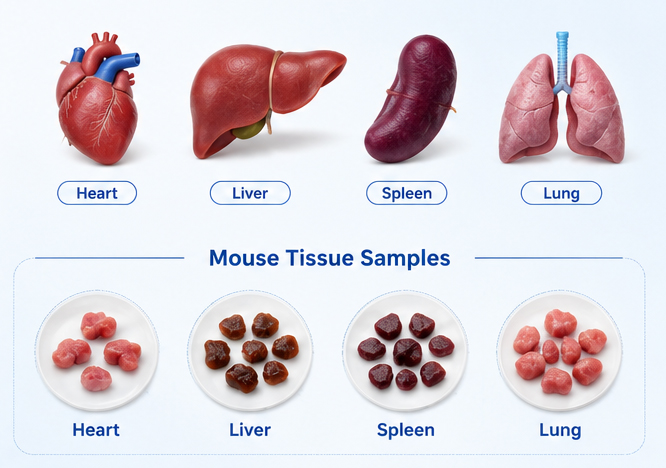
Experimental Objective
Mouse heart, liver, spleen and lung tissues were selected for this application. The objective was to evaluate the grinding and homogenization performance of the equipment and establish suitable sample preparation conditions for subsequent DNA, RNA and protein extraction.
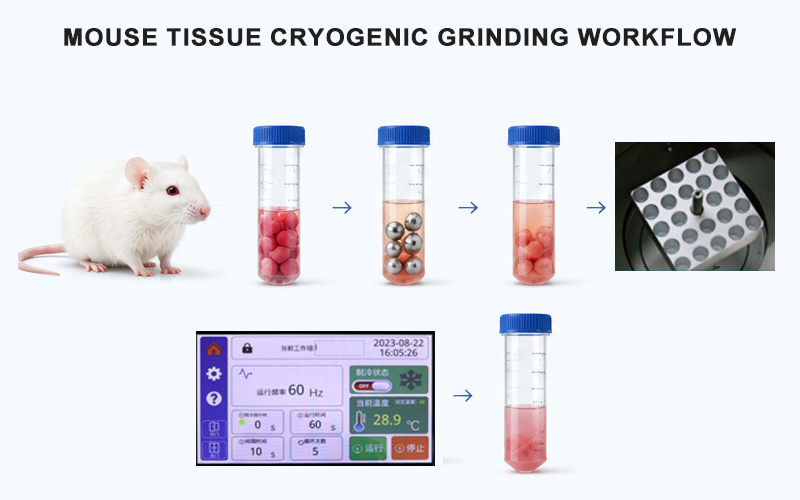
Mouse Tissue Grinding Procedure
Turn on the equipment and activate the pre-cooling function according to the experimental requirements.
Weigh approximately 100 mg of each mouse tissue sample and place it into screw-cap grinding tubes.
Select suitable grinding bead sizes and quantities according to the tissue type.
Add the required buffer or extraction solution according to the downstream application.
Place the sample tubes into the appropriate adapter and ensure proper balancing.
Set the grinding frequency, processing time and temperature according to the sample characteristics.
Start the grinding program. After completion, remove the tubes and evaluate the tissue disruption and homogenization results.
Experimental Results
The mouse heart, liver, spleen and lung tissues were processed for 3 minutes.
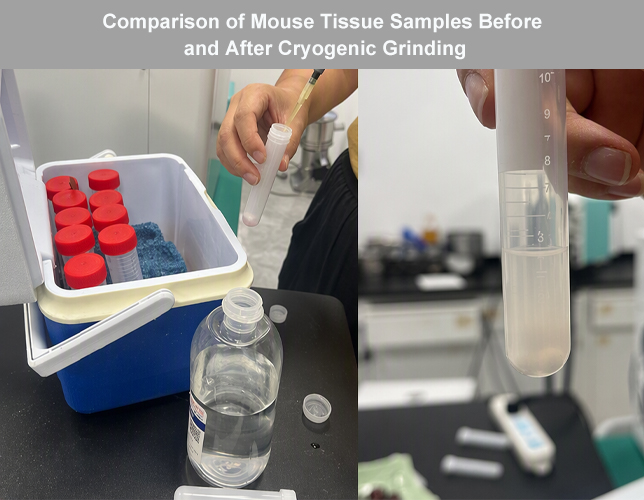
The resulting samples showed effective tissue disruption and homogenization. By selecting appropriate bead sizes and quantities and optimizing the grinding parameters, the process can be adapted to different tissue structures, helping reduce residual tissue and uneven grinding commonly associated with manual processing.
Experimental images: Comparison of mouse tissue samples before and after grinding
Reference Grinding Parameters for Different Animal Tissues
Different tissues vary in hardness, fibrous structure and moisture content. Actual conditions should be adjusted according to sample type, sample quantity and the downstream extraction method.
Tissue Type | Recommended Grinding Beads | Frequency | Time |
Heart, kidney, muscle | 1 large bead + 2 small beads | 65 Hz | Approx. 60 s |
Stomach, intestine, lung | 1 large bead + 2 small beads | 65 Hz | 90–120 s |
Liver, brain, spleen | 1–2 small beads | 60 Hz | 45–60 s |
Skin, adipose tissue | 2 large beads + 1 small bead | 65 Hz | 80–90 s |
Blood vessels | 1–2 small beads | 60 Hz | Approx. 60 s |
These parameters are provided as experimental references. Actual conditions should be optimized according to tissue type, sample quantity, bead size and the intended application.
Suitable for DNA, RNA and Protein Extraction
DNA Extraction:
Bead size can be selected according to tissue hardness. For relatively difficult-to-grind tissues such as heart, kidney and muscle, a combination of large and small beads can improve tissue disruption.
RNA Extraction:
Low-temperature processing is recommended. Appropriate RNA extraction reagents, such as TRIzol, can be added according to the experimental protocol. Proper control of grinding time and temperature helps produce a more uniform tissue homogenate.
Protein Extraction:
Grinding time can be adjusted according to tissue type. Smaller beads are suitable for relatively easy-to-grind tissues such as liver, brain and spleen, while a combination of large and small beads can be used for tissues such as heart, kidney and muscle.
Liquid Nitrogen Cryogenic Grinding
For temperature-sensitive samples or difficult-to-grind materials such as plant roots, stems, skin, bone and hair, liquid nitrogen pre-freezing can be used before grinding.
Samples can be cut into smaller pieces and placed into grinding tubes with suitable beads. After freezing with liquid nitrogen, an appropriate frequency and processing time can be selected according to the sample characteristics. If additional disruption is required, the sample can be frozen again and subjected to a second grinding cycle.
WCM600 for Biological Tissue Grinding
For animal tissues, plant tissues and other temperature-sensitive biological samples, selecting an appropriate grinding system is important for achieving consistent sample preparation.
The WCM600 supports simultaneous processing of multiple sample tubes and allows adjustment of grinding temperature, frequency and processing time. It can be used for the disruption and homogenization of various biological tissues, including heart, liver, lung, kidney, brain and muscle.
For detailed specifications, compatible samples and configurations, please visit the WCM600 Cryogenic Mill product page or contact the Welso sales team for application-specific recommendations.
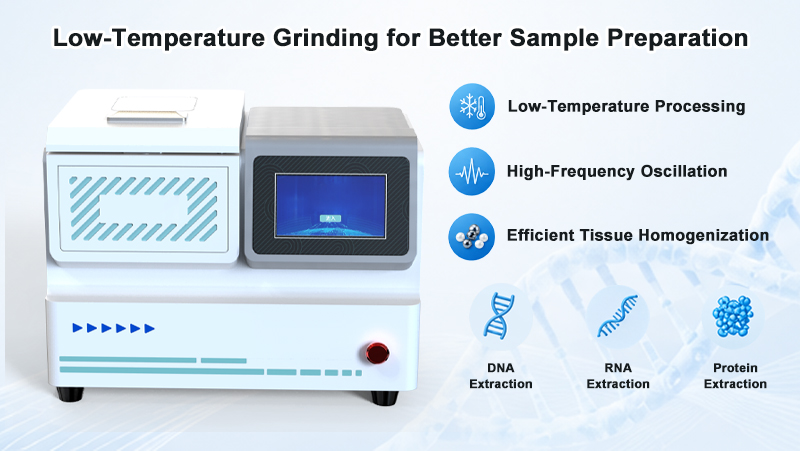
Key Advantages
Cryogenic processing: Suitable for temperature-sensitive biological samples.
High-frequency oscillation: Enhances tissue disruption through impact, friction and shearing forces.
Adjustable parameters: Frequency and processing time can be optimized for different samples.
Flexible bead selection: Different bead sizes and quantities can be selected according to tissue characteristics.
Effective homogenization: Helps produce more uniform tissue homogenates.
Wide applications: Suitable for animal and plant tissue preparation for DNA, RNA and protein extraction.
Mouse tissue grinding is an important step in biological sample preparation, and the quality of tissue disruption can affect subsequent nucleic acid and protein extraction.
With low-temperature processing, high-frequency oscillation and flexible bead configurations, the WCM600 provides efficient and consistent grinding and homogenization of mouse heart, liver, spleen and lung tissues. It helps address common challenges associated with manual grinding and incomplete tissue disruption, providing a practical solution for biomedical research, molecular biology and laboratory sample preparation.
For special or difficult-to-grind samples, grinding bead size, frequency, processing time and temperature can be further optimized according to specific sample characteristics.

Subscribe to our Newsletter & Event right now to updated.



+86 21 51096910

sales@welsobio.com
marketing@welsobio.com

1-1009, National Industrial Design Park, No. 599 Jianzhu Road, Binhu, Wuxi , Jiangsu, China, 214062

Head Office: No. 439 Jinglian Road, Minhang District, Shanghai,China, 201108